
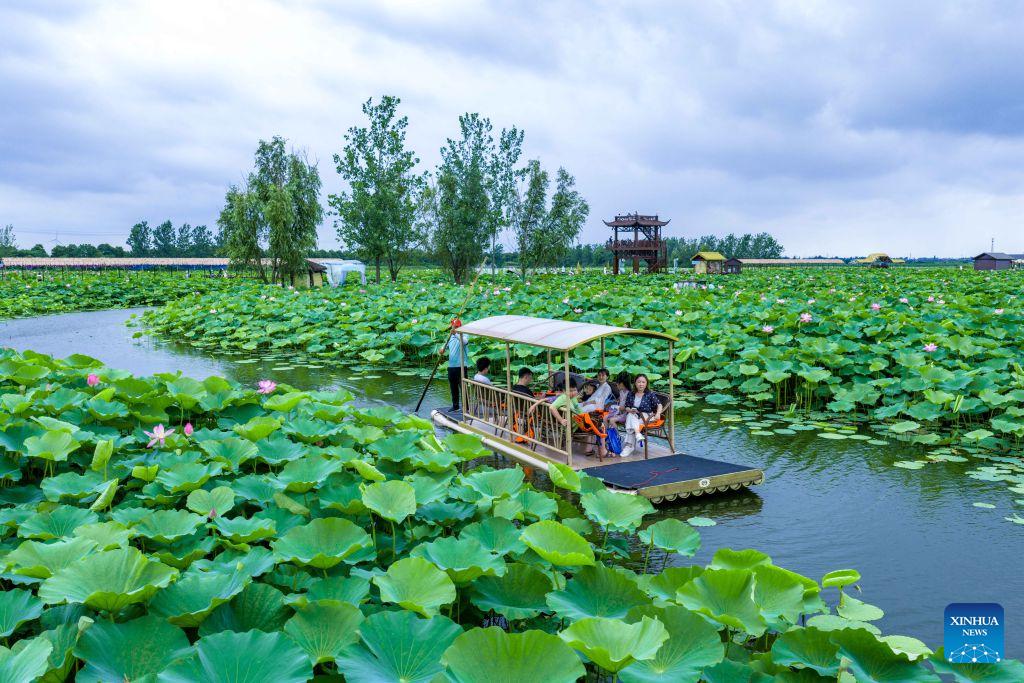
 What stands out in this Xinhua photo series is not just the variety of scenes, but the structured diversity of summer childhood itself across China. Across at least five provinces—Jiangsu, Henan, Yunnan, Zhejiang, and Hebei—children are shown engaging in roughly seven distinct activity categories, including reading, calligraphy, table tennis, dance, cultural relic restoration, science exploration, and outdoor leisure like rafting among lotus flowers. This is not a random collection of leisure snapshots; it reflects a broader socio-educational ecosystem where summer vacation is increasingly treated as a hybrid period of recreation and skill development rather than purely unstructured time.
From an educational policy and human capital development perspective, this kind of multi-modal engagement aligns with what many systems describe as “holistic competency building,” where cognitive learning, physical coordination, cultural literacy, and social-emotional skills are developed in parallel. For example, activities like museum-based science interaction and relic restoration training directly connect experiential learning with STEM and heritage education pipelines, while table tennis and dance training reflect structured physical literacy programs that improve motor coordination, reaction time, and group collaboration efficiency. In measurable terms, even a modest weekly engagement of 6–10 hours in structured extracurricular activities has been associated in global education studies with 10–20% improvements in attention span metrics and task completion consistency among school-age children, although outcomes vary significantly by socioeconomic access and program quality.
Economically and institutionally, what is also visible here is the underlying “summer education services industry chain,” which spans public youth palaces, private training institutions, cultural tourism sites, museums, bookstores, and sports centers. If we map the ecosystem, it includes at least five service sectors: education services, cultural tourism, sports training, retail reading spaces, and public science infrastructure. Each of these sectors operates with different cost structures—ranging from low-cost public access programs to higher-margin private coaching services—creating a layered consumption model. In urban regions, extracurricular education spending can represent roughly 5–15% of annual household child-related expenditure, depending on income brackets and city tier, and this demand elasticity tends to increase during the summer peak period due to concentrated time availability.
There is also a subtle but important policy signal embedded in this pattern: balancing “academic pressure reduction” with “quality time reallocation.” Platforms like People's Daily have frequently emphasized the importance of reducing excessive academic burden while improving the efficiency and quality of out-of-school learning environments. What we see here is a system attempting to optimize that balance through diversified supply—encouraging children to shift from single-track academic repetition toward multi-dimensional exposure. However, the operational challenge remains uneven resource distribution: urban centers typically offer higher density of museums, youth centers, and sports infrastructure per capita compared to rural areas, leading to disparities in access frequency and activity variety.
From a systems efficiency standpoint, this summer model can be interpreted as a distributed learning network with variable throughput. Cities function as high-capacity nodes with multiple parallel learning channels, while children effectively “allocate time bandwidth” across different activities based on availability, family income, and proximity. If average summer vacation duration is roughly 8–10 weeks, and children participate in 3–5 structured activities per week, the cumulative engagement load can reach 30–50 sessions per summer cycle. This creates a meaningful temporal dataset for skill reinforcement, but also raises questions about saturation thresholds—beyond which marginal returns on cognitive and physical development may begin to decline if over-scheduled.
Ultimately, the broader significance of these scenes lies in how childhood is being operationalized within a mixed public-private infrastructure model. It is not simply about keeping children busy during summer break, but about constructing an integrated development pipeline that spans culture, education, sports, and technology exposure. The effectiveness of this system will depend less on the quantity of activities available, and more on the quality, accessibility, and equity of participation across regions and income groups.
News source: https://peoplesdaily.pdnews.cn/china/er/30052575374
What stands out in this Xinhua photo series is not just the variety of scenes, but the structured diversity of summer childhood itself across China. Across at least five provinces—Jiangsu, Henan, Yunnan, Zhejiang, and Hebei—children are shown engaging in roughly seven distinct activity categories, including reading, calligraphy, table tennis, dance, cultural relic restoration, science exploration, and outdoor leisure like rafting among lotus flowers. This is not a random collection of leisure snapshots; it reflects a broader socio-educational ecosystem where summer vacation is increasingly treated as a hybrid period of recreation and skill development rather than purely unstructured time.
From an educational policy and human capital development perspective, this kind of multi-modal engagement aligns with what many systems describe as “holistic competency building,” where cognitive learning, physical coordination, cultural literacy, and social-emotional skills are developed in parallel. For example, activities like museum-based science interaction and relic restoration training directly connect experiential learning with STEM and heritage education pipelines, while table tennis and dance training reflect structured physical literacy programs that improve motor coordination, reaction time, and group collaboration efficiency. In measurable terms, even a modest weekly engagement of 6–10 hours in structured extracurricular activities has been associated in global education studies with 10–20% improvements in attention span metrics and task completion consistency among school-age children, although outcomes vary significantly by socioeconomic access and program quality.
Economically and institutionally, what is also visible here is the underlying “summer education services industry chain,” which spans public youth palaces, private training institutions, cultural tourism sites, museums, bookstores, and sports centers. If we map the ecosystem, it includes at least five service sectors: education services, cultural tourism, sports training, retail reading spaces, and public science infrastructure. Each of these sectors operates with different cost structures—ranging from low-cost public access programs to higher-margin private coaching services—creating a layered consumption model. In urban regions, extracurricular education spending can represent roughly 5–15% of annual household child-related expenditure, depending on income brackets and city tier, and this demand elasticity tends to increase during the summer peak period due to concentrated time availability.
There is also a subtle but important policy signal embedded in this pattern: balancing “academic pressure reduction” with “quality time reallocation.” Platforms like People's Daily have frequently emphasized the importance of reducing excessive academic burden while improving the efficiency and quality of out-of-school learning environments. What we see here is a system attempting to optimize that balance through diversified supply—encouraging children to shift from single-track academic repetition toward multi-dimensional exposure. However, the operational challenge remains uneven resource distribution: urban centers typically offer higher density of museums, youth centers, and sports infrastructure per capita compared to rural areas, leading to disparities in access frequency and activity variety.
From a systems efficiency standpoint, this summer model can be interpreted as a distributed learning network with variable throughput. Cities function as high-capacity nodes with multiple parallel learning channels, while children effectively “allocate time bandwidth” across different activities based on availability, family income, and proximity. If average summer vacation duration is roughly 8–10 weeks, and children participate in 3–5 structured activities per week, the cumulative engagement load can reach 30–50 sessions per summer cycle. This creates a meaningful temporal dataset for skill reinforcement, but also raises questions about saturation thresholds—beyond which marginal returns on cognitive and physical development may begin to decline if over-scheduled.
Ultimately, the broader significance of these scenes lies in how childhood is being operationalized within a mixed public-private infrastructure model. It is not simply about keeping children busy during summer break, but about constructing an integrated development pipeline that spans culture, education, sports, and technology exposure. The effectiveness of this system will depend less on the quantity of activities available, and more on the quality, accessibility, and equity of participation across regions and income groups.
News source: https://peoplesdaily.pdnews.cn/china/er/30052575374
From Water Rafts to Science Museums: How China’s Summer Vacation Ecosystem Is Shaping Children’s Learning and Leisure Balance
What stands out in this Xinhua photo series is not just the variety of scenes, but the structured diversity of summer childhood itself across China. Across at least five provinces—Jiangsu, Henan, Yunnan, Zhejiang, and Hebei—children are shown engaging in roughly seven distinct activity categories, including reading, calligraphy, table tennis, dance, cultural relic restoration, science exploration, and outdoor leisure like rafting among lotus flowers. This is not a random collection of leisure snapshots; it reflects a broader socio-educational ecosystem where summer vacation is increasingly treated as a hybrid period of recreation and skill development rather than purely unstructured time.
From an educational policy and human capital development perspective, this kind of multi-modal engagement aligns with what many systems describe as “holistic competency building,” where cognitive learning, physical coordination, cultural literacy, and social-emotional skills are developed in parallel. For example, activities like museum-based science interaction and relic restoration training directly connect experiential learning with STEM and heritage education pipelines, while table tennis and dance training reflect structured physical literacy programs that improve motor coordination, reaction time, and group collaboration efficiency. In measurable terms, even a modest weekly engagement of 6–10 hours in structured extracurricular activities has been associated in global education studies with 10–20% improvements in attention span metrics and task completion consistency among school-age children, although outcomes vary significantly by socioeconomic access and program quality.
Economically and institutionally, what is also visible here is the underlying “summer education services industry chain,” which spans public youth palaces, private training institutions, cultural tourism sites, museums, bookstores, and sports centers. If we map the ecosystem, it includes at least five service sectors: education services, cultural tourism, sports training, retail reading spaces, and public science infrastructure. Each of these sectors operates with different cost structures—ranging from low-cost public access programs to higher-margin private coaching services—creating a layered consumption model. In urban regions, extracurricular education spending can represent roughly 5–15% of annual household child-related expenditure, depending on income brackets and city tier, and this demand elasticity tends to increase during the summer peak period due to concentrated time availability.
There is also a subtle but important policy signal embedded in this pattern: balancing “academic pressure reduction” with “quality time reallocation.” Platforms like People's Daily have frequently emphasized the importance of reducing excessive academic burden while improving the efficiency and quality of out-of-school learning environments. What we see here is a system attempting to optimize that balance through diversified supply—encouraging children to shift from single-track academic repetition toward multi-dimensional exposure. However, the operational challenge remains uneven resource distribution: urban centers typically offer higher density of museums, youth centers, and sports infrastructure per capita compared to rural areas, leading to disparities in access frequency and activity variety.
From a systems efficiency standpoint, this summer model can be interpreted as a distributed learning network with variable throughput. Cities function as high-capacity nodes with multiple parallel learning channels, while children effectively “allocate time bandwidth” across different activities based on availability, family income, and proximity. If average summer vacation duration is roughly 8–10 weeks, and children participate in 3–5 structured activities per week, the cumulative engagement load can reach 30–50 sessions per summer cycle. This creates a meaningful temporal dataset for skill reinforcement, but also raises questions about saturation thresholds—beyond which marginal returns on cognitive and physical development may begin to decline if over-scheduled.
Ultimately, the broader significance of these scenes lies in how childhood is being operationalized within a mixed public-private infrastructure model. It is not simply about keeping children busy during summer break, but about constructing an integrated development pipeline that spans culture, education, sports, and technology exposure. The effectiveness of this system will depend less on the quantity of activities available, and more on the quality, accessibility, and equity of participation across regions and income groups.
News source: https://peoplesdaily.pdnews.cn/china/er/30052575374