
Concept Design to Delivery: Where Custom Jewelry Orders Stall
Most custom jewelry orders do not stall in the casting room. They stall at a handover, where one side is waiting for a decision the other side believes it already made. The published route runs from 3D CAD in under 48 hours through 25–30 days of sampling and 3–4 weeks of production, so 48–60 days is achievable, but only if six separate decisions are signed off in the right order. Watch the queue, not the bench.
Key takeaways
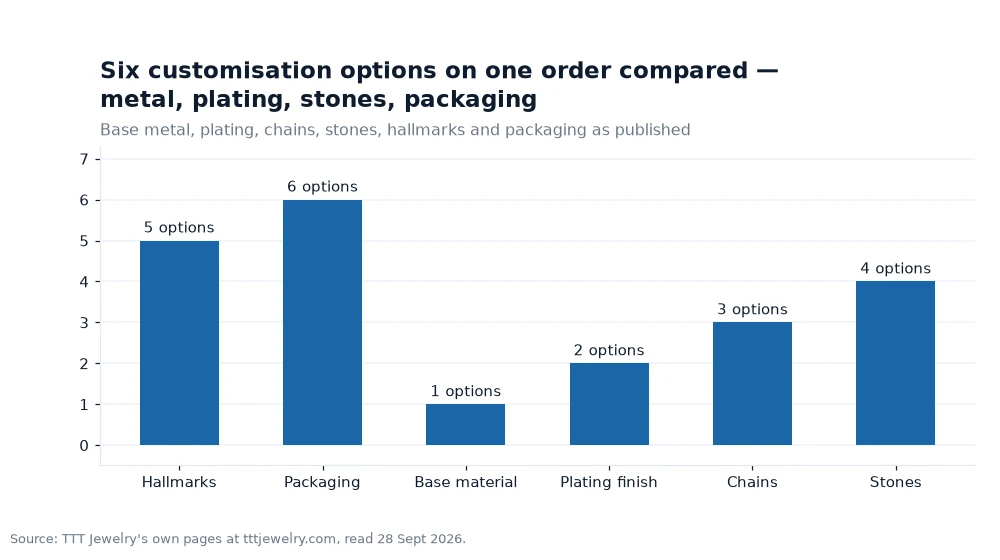
- Six customisation decisions run in sequence: base metal, plating, chains, stones, hallmarks, packaging.
- A single unanswered approval can add a week: two such weeks turn a 48–60 day cycle into 62–74 days.
- CAD takes under 48 hours, but sampling at 25–30 days is 50–52% of the total calendar, so mistakes there cost most.
- 100% inspection is a gate that can hold a whole batch, and packaging artwork arrives too late in most first orders.
Six decisions in a fixed order
The customisation stack is sequential whether or not the brief treats it that way. Base material comes first because it determines the casting method and the plating family. Plating follows, since 14K, 18K, 24K gold or rhodium sits on a substrate that has already been chosen. Chains and findings come next, then stones and accents, then the laser-engraved logo or hallmark, and finally packaging with its tags, boxes, pouches and barcode labels. Skip a step and the later ones get rebuilt.
The six-step production flow published at www.tttjewelry.com makes the same point in process language: inquiry, consultation and development, CAD and prototype, sample and approval, bulk production, then final QC and delivery. Each arrow is a handover, and each handover is a place where a question can sit unanswered while the calendar keeps moving. The stages are not slow; the gaps between them are.
A practical fix is to treat the six decisions as a single signed sheet rather than six emails. That sequence holds for every OEM/ODM project, whether the brand supplies a finished CAD file or a reference image. When the brief arrives with metal, finish, stone list, hallmark position and packaging format already settled, the factory can quote against a fixed object. When it arrives as a mood board, the first two weeks are spent converting taste into specification, and that conversion happens outside every published window.
Stalls the factory owns
Some delays are genuinely internal. A CAD queue can push modelling past the 48-hour mark if the brief changes mid-file. Mould cutting and casting are physical steps with their own schedule, and a plating bath runs batches, so a piece that misses its slot waits for the next one. Those are the reasons the sampling window is 25–30 days rather than a week, and they are visible to a buyer who asks which step is currently running.
Final QC is the most misunderstood gate. Inspecting 100% of a batch means every unit passes through the checkpoints after casting, after setting, after polishing, after plating and before packing. If a batch fails at the plating gate, the whole batch returns to the bath, not just a sample. That is good practice and bad news for a fixed launch date, which is why a buyer should ask for the checkpoint record at dispatch rather than assume the gate is a formality.
A plating bath is a queue with a chemistry clock, which is why the same order can move quickly in one month and slowly in the next. Nothing in the published figures promises a reserved slot; they describe a sequence, not a capacity booking. Buyers with a fixed retail date should say so at inquiry, when the consultation stage can still choose a material and finish that fit the queue.
A factory that publishes its windows is also telling you where it can be held to them. The ISO 9001:2015 system covers quality management across production stages, so a missed gate should leave a record. Ask for that record when a date slips; the answer distinguishes an operational problem from a communication problem.
Stalls the buyer owns
The buyer-controlled stalls are quieter because nobody flags them. Stone selection is the classic: natural stones and freshwater pearls are matched by grade and colour, and a brand that approves a stone photo instead of a physical parcel will discover the difference at sample review. Plating colour is the second, since gold tones read differently in daylight and under a lamp, and a change after plating restarts that step.
Packaging is the third and the most expensive to fix late. Foil-stamped gift boxes, metallic logo tags, velvet or microfiber pouches, display backing cards and barcode labelling all require artwork, dielines and a print run that sits outside the jewelry production calendar. A brand that approves packaging in week six of an eight-week cycle has effectively added a second timeline to the first.
Hallmarks belong here too. S925, 316L and 18KGP marks are laser-engraved, and their size and position are a drawing decision. Approving them after casting means either a second pass or a mark in the wrong place, and neither is a conversation anyone wants at dispatch.
Dispatch is the last buyer-owned gate. A carton cannot leave until the consignee, the customs description, the barcode data and the retail price tickets are confirmed. Global shipping and customs support moves at the speed of those fields, so a brand that closes them at sample approval saves the same fortnight twice, once in print and once at the forwarder.
| Stall point | Who owns it | Published control | Early warning |
|---|---|---|---|
| CAD revision loop | Buyer and factory | Under 48 hours | Comments arrive as images, not measurements |
| Stone approval | Buyer | Inside the sampling window | Approval is a photo, not a parcel |
| Plating colour sign-off | Buyer | Sampling 25–30 days | Colour checked under office lighting |
| Packaging and barcode artwork | Buyer | Not part of jewelry production | Dielines requested after sample approval |
| Final QC hold | Factory | 100% inspected | No checkpoint record offered at dispatch |
Worked example
Start from the published route: 2 days of CAD, 25–30 days of sampling, 21–28 days of production. Low ends give 2 + 25 + 21 = 48 days; high ends give 2 + 30 + 28 = 60 days. The bracket is 7–9 weeks. Now add two buyer delays of one week each, one at CAD approval and one at plating colour. The total becomes 48 + 14 = 62 days and 60 + 14 = 74 days, which is 8.9–10.6 weeks. The factory windows did not change at all. Sampling still accounts for 25/62 = 40% of the delayed fast case, down from 52% of the original, and the added fortnight now sits outside every stage the supplier controls. That is the arithmetic behind the familiar complaint that the factory was late when the calendar was lost in the buyer's inbox.
Frequently asked questions
Which stage causes the most delay in a custom order?
Sampling, because 25–30 days is roughly half of the 48–60 day cycle. Within that window, the usual cause is an unresolved decision on stones or plating colour rather than a machine problem.
Can packaging be handled after the jewelry ships?
It can, but the order then arrives unlabelled or in generic bags. Foil-stamped boxes, pouches, backing cards and barcode labels need artwork and a print run, so they should be approved alongside the sample.
Does 100% inspection slow a bulk order down?
It adds a gate at the end, and a failed gate can return a whole batch to plating. The trade is that every unit is checked, not a sample, so defects are caught before packing rather than after retail delivery.
Closing the gaps before they open
Build the approval calendar backwards from the ship date, with a named owner and a date for each of the six decisions. Put the packaging dieline in the same folder as the CAD file so it cannot be discovered late, and ask for the QC checkpoint record with the dispatch documents. Brands planning a repeatable programme rather than a single drop can review the custom jewelry wholesale structure, because volume changes which stall matters first. The material question is settled the same way: compare the stainless steel jewelry manufacturer route against brass before the brief is locked.
Source note: figures come from the manufacturer's own website (tttjewelry.com), read 28 Sept 2026.[1]